
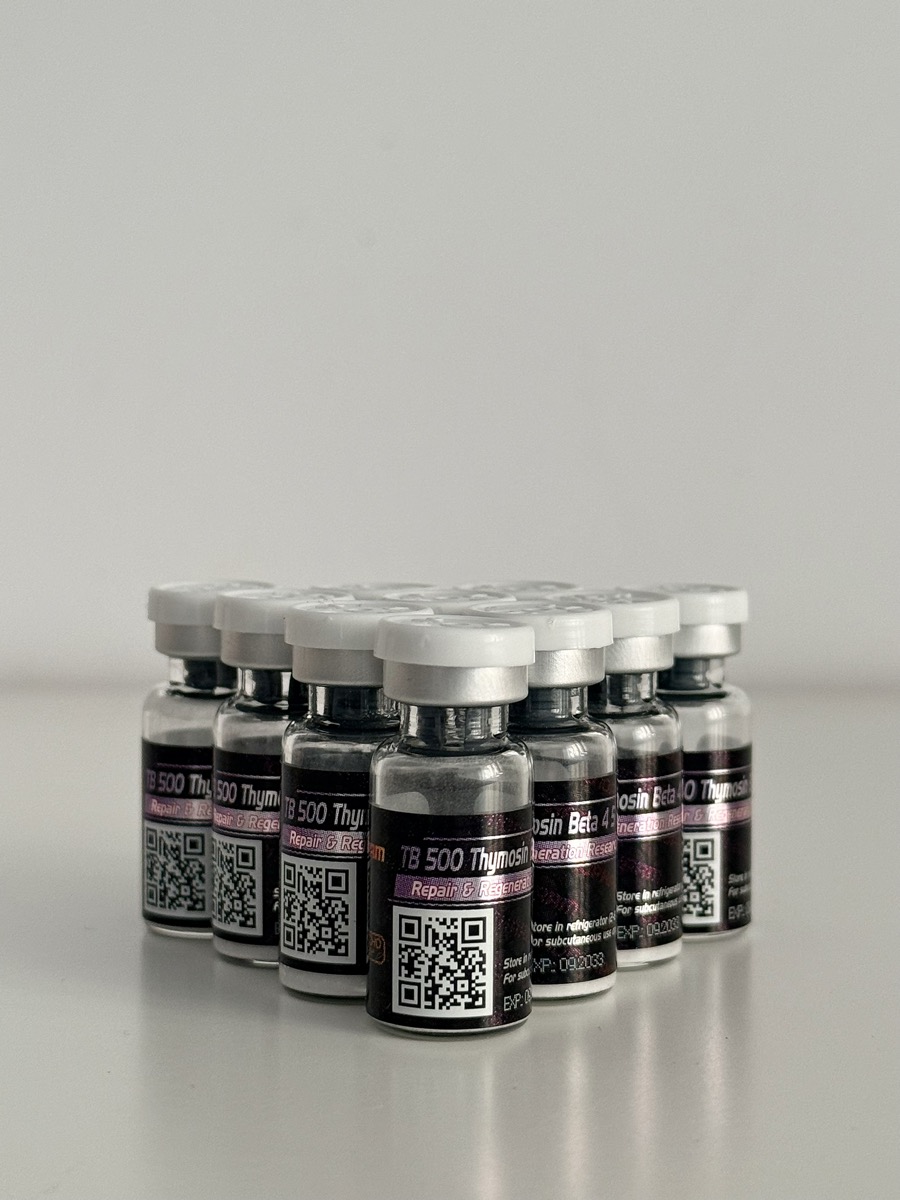

The compound behind the label
Thymosin Beta-4 (TB-4) is a 43-amino-acid protein present in practically every human cell. The highest concentrations sit in the thymus, spleen, platelets and activated immune cells. TB-500 isn’t a 1:1 copy of the full protein — it’s a synthetic peptide fragment reproducing the central actin-binding regions of TB-4.
What makes the peptide mechanistically distinctive is its role in the actin cytoskeleton. Actin is the structural protein that drives cell movement, cell division and shape changes. Without a functioning actin network, cells can’t migrate or divide. When there’s an injury, the repair cells — fibroblasts, endothelial cells, myoblasts — need to migrate out of surrounding tissue toward the damage site. TB-500 acts right there, as a regulator of that cell migration.
What Genopharm ships
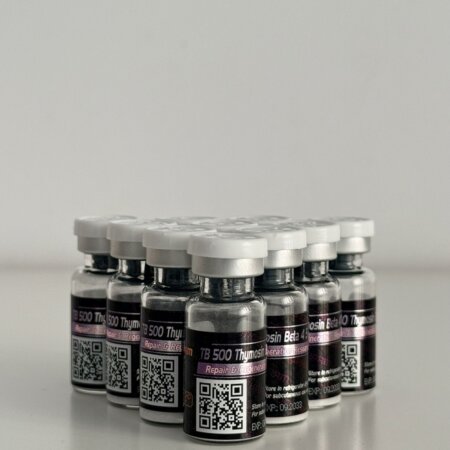
Genopharm is a supplier that has specialised in lyophilised batches with consistent purity in the peptide segment. The 5 mg vial contains pure peptide as dry powder — no additives, no stabilisers. For typical user protocols with 2–2.5 mg per injection, one vial covers 2–3 weeks of a loading phase.
How TB-500 works in the body
The effects split into several layers:
Actin binding and cell migration. TB-500 binds G-actin (globular actin) and regulates actin polymerisation. Repair cells move faster toward the injury site; the actual tissue repair flows more smoothly.
Angiogenesis. Like BPC-157, TB-500 promotes the formation of new capillaries — new blood vessels supply injured tissue with oxygen and nutrients. The attack point is different (NO system for BPC vs. actin regulation for TB), the endpoint overlaps.
Inflammation modulation. TB-500 reduces inflammatory cytokines (IL-1β, TNF-α) in the acute phase of an injury, without completely suppressing the base inflammation that repair itself needs — a balancing act any good wound modulator does.
Collagen support. Fibroblast activity and new collagen formation get triggered too, though less directly than under BPC-157.
The big split from BPC-157 sits in the site of action: BPC works mainly locally and in the GI tract, TB-500 works systemically. After a subcutaneous shot the peptide distributes across the entire body and can become active at distant sites. That’s the reason some users stack BPC and TB-500 — the famous “Wolverine stack” combination, named after the Marvel character with the near-superhuman regeneration.
Where users reach for it
Reports on peptide forums paint a pattern:
- Recovery after intense training and system-shock loading
- Support during acute muscle-fibre injuries and tendon irritation
- Better joint mobility, particularly with chronic complaints
- Regeneration after orthopaedic surgery (meniscus, ACL, rotator cuff)
- Reduction of training-related pain and inflammation
Expectation management matters: the effects are subtler than anabolic steroids and take time. First perceptions after 10–14 days, real improvements in load tolerance typically after 4–6 weeks. Anyone hoping for a three-day Wolverine miracle will be disappointed.
Legal picture and WADA
TB-500 is not approved as a medicine in any country for human use. The FDA has it in Category 2 of the compounding bulk list — the highest risk class. On the WADA Prohibited List 2026 the compound sits in category S0 (non-approved substances), banned at all times for tested athletes. For competitive sport TB-500 is not an option.
One safety point the community rarely discusses: TB-500 promotes angiogenesis. New vessel formation is welcome in healthy tissue but could be problematic in undetected tumours. Preclinical data on TB-4 have debated whether angiogenesis favours tumour growth. For anyone with an oncological history it’s a strong argument against use.
Instructions
Reconstitution of the vial
The 5 mg vial is drawn up with bacteriostatic water. Common dilutions:
- 2 ml water → 2.5 mg/ml → 1 ml = 2.5 mg
- 5 ml water → 1 mg/ml → 2 ml = 2 mg
- 2.5 ml water → 2 mg/ml → 1 ml = 2 mg
Spray water slowly onto the inner wall, not straight onto the powder. Roll the vial for 30 seconds between your palms — never shake, that can create peptide aggregates. After reconstitution the solution should be clear, without visible cloudiness or particles.
Dosing patterns from community practice
| Phase | Dose | Frequency | Duration |
|---|---|---|---|
| Loading | 2–5 mg | 2× per week | 2–4 weeks |
| Maintenance | 2–2.5 mg | 1× per week | 4–8 weeks |
Loading with a higher frequency builds tissue concentration faster. From week 4 you drop back to a weekly maintenance shot. A full cycle typically runs 6–12 weeks; continuous use across several months isn’t recommended in the community because effect seems to fade after longer periods.
Because the peptide works systemically, the injection site isn’t critical — abdomen, outer thigh, deltoid all workable.
Injection technique
Subcutaneous or intramuscular, both work. For 2–2.5 mg doses at 1 mg/ml dilution you need 2–2.5 ml of volume, which is a lot for SC — switching to 2.5 mg/ml pays off there. For smaller volumes (0.5–1 ml) an insulin syringe 30G × 8 mm is enough; for larger volumes, 25G–27G × 12–16 mm.
Wait at least 30 seconds after injection before removing the needle — cuts down on solution backflow. Rotate sites to keep local reactions to a minimum.
Storage
Before reconstitution: fridge at 2–8 °C, protected from light.
After reconstitution: fridge at 2–8 °C, use within 3–4 weeks. Do not freeze — the peptide tolerates freeze-thaw cycles badly. Anyone stretching a vial across two months has noticeably reduced activity in the final weeks.
Combining with BPC-157
The classic Wolverine stack: BPC-157 at smaller doses more often (250 µg 1–2× daily), TB-500 at larger doses once a week (2–2.5 mg). Some users mix both peptides in one syringe — not optimal from a sterility standpoint, but workable if both vials come from clean batches. No controlled clinical studies exist on this combination — the practice rests on empirical knowledge only.


Reviews
There are no reviews yet